

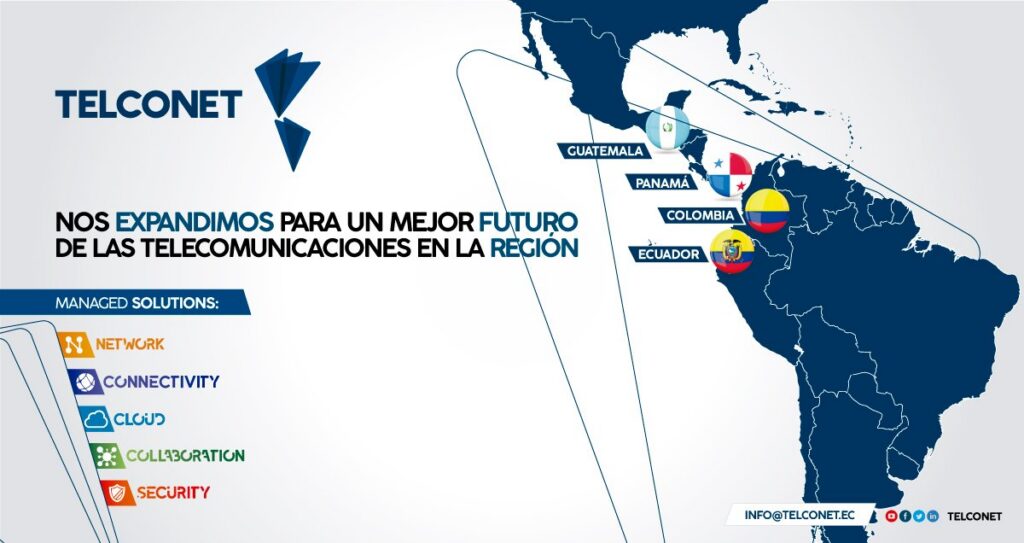
Telconet will bring three new data centers into operation in Ecuador, Panama and Colombia before the end of 2026, advancing its regional digital infrastructure strategy to meet the growing demand for cloud, connectivity and artificial intelligence services.
The company recently inaugurated its third data center in Ecuador.
According to Francisco Villacreses, commercial vice president of Telconet Latam, a fourth facility in Ecuador will come into operation in the third quarter, while the centers in Panama and Barranquilla, Colombia, will be completed during the fourth quarter.
We have two facilities in Ecuador, built and in operation since 2012 and 2013 respectively. In 2026, we will inaugurate the third; in September, the fourth in Ecuador; and the fifth (Panama) and the sixth (Barranquilla) will be completed by the fourth quarter of 2026,” Villacreses said.
The new centers are part of a previously announced strategy to develop eight edge data centers linked to the company’s submarine network cable landing stations.
The seventh data center, located in Bonita Springs, United States, will be available in the second quarter of 2027, while the eighth will be built in Quito and will enter into operation during the third quarter of 2028, Villacreses revealed.
“The latter, exclusively focused on AI (which promises to be the largest in the Andean region), will start with 10 MW and is projected to reach 100 MW,” said the executive.
Expansion
As BNamericas first reported, Telconet announced a investment plan of US$550 million (mn) through 2027 to strengthen its digital infrastructure in Latin America.
The investment includes the expansion of the regional edge data center platform, as well as the strengthening of international connectivity through new submarine cable capacity.
With this, the company seeks to position itself as a regional provider of digital infrastructure to meet the growing demand for cloud services, data processing, and AI.
In parallel, Telconet is moving forward with the deployment of its regional submarine cable network. The Carnival Submarine Network-1 system (CSN-1), 4,500 km long and built by Alcatel Submarine Networks (ASN), will connect Florida’s west coast with Panama, Colombia and Ecuador. The cable landed in Colombia in October and later in Anconcito, Ecuador, in February.
The company also reported that it completed the final splice of the Pacific segment of CSN-1, a key technical step to ensure the continuous transmission of long-distance data. The vessel in charge of the installation is in the Caribbean to deploy the last section of the system. Commissioning is scheduled for the second half of 2026.
Telconet is also driving the CSN-2 project, a new submarine cable designed to meet the growth of artificial intelligence and hyperscale operators. The system will connect Veracruz, Mexico, with the Apalachee Beach area in northern Florida, and will include a branch to Galveston, Texas, with access to the Houston market. The company is also evaluating an additional connection to Bonita Beach to interconnect with CSN-1.
As part of this initiative, the Mexican company C3ntro Telecom joined the project and agreed with Telconet to build a new terrestrial fiber-optic segment between Querétaro and Veracruz to integrate CSN-2 with C3ntro’s Tikva network. The infrastructure aims to connect one of Mexico’s main data center hubs with the new submarine route.
Additionally, Telconet is participating together with the local provider SALT Wireless and Cayman Cable Co. in a consortium for a bidding process by the government of the Cayman Islands aimed at the development of a new international subsea cable.
The project seeks to strengthen the connectivity of the territory, currently served by the CJFS and Maya-1 systems, operated by Liberty Networks since the late 1990s.