

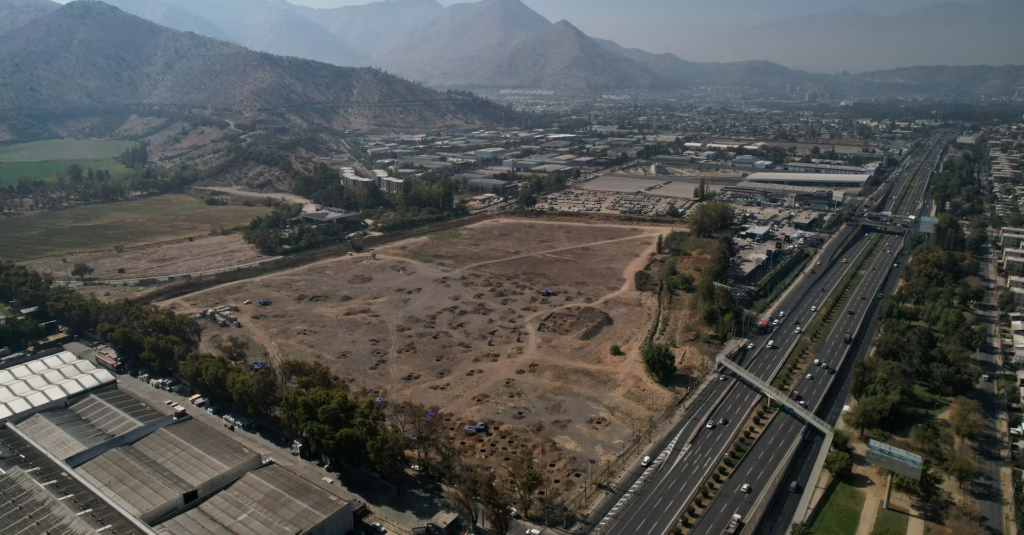
Patricio Hernandez lives on the northern outskirts of Chile’s capital Santiago, a hilly area below the Andes mountains which he and other residents fear could be devastated by a major Amazon (AMZN.O), opens new tab data center complex.
“This hill is very important to the community; it is a green space, a place for recreation and for community,” he said, while strolling dirt paths near a flowing stream.
He and other residents tried to block the data center, arguing the permit did not take into account the potential construction of a high-voltage power line that they said would be needed to feed the site.
Environmental authorities in early April ruled the data center could move ahead, saying that any plans for a power line should be assessed separately.
Amazon Web Services said it aims for the data center to consume minimal energy and water and that its plan had met the environmental requirements.
Data center construction has taken off worldwide as demand grows for the physical backbone for data storage, computer processing and artificial intelligence. So too has opposition over fears that the energy and water consumption required by data centers could drain resources, and that data centers could generate heat, cause noise pollution and rely on fossil fuels.
Kazakhstan holds an estimated 33 billion tons of coal reserves, enough to last 300 years at present consumption levels. Tokayev called for coal to be treated as a strategic resource, with the application of modern environmental technologies to reduce its environmental impact.
The president instructed the government to present a proposal by March 20 to grant coal generation the status of a national project. Planned energy infrastructure projects include new coal-fired thermal plants in Kokshetau, Semey, and Oskemen, the commissioning of a plant in Kurchatov, and the expansion of GRES-2 and construction of GRES-3 in Ekibastuz.
Simultaneously, the government aims to speed up the deployment of balancing capacities, particularly gas-based generation. However, Tokayev also warned of a worsening gas deficit: in 2024, Kazakhstan’s commercial gas imports surged by 18%, reaching 4.5 billion cubic meters.
“Our approach has been to design this infrastructure with a strong emphasis on resource efficiency, incorporating technologies that minimize both energy and water consumption,” AWS Southern Cone technology chief Rafael Mattje said, speaking from New Zealand.
The branch of Jeff Bezos’ tech giant responsible for data centers last year announced a major plan to expand in Santiago.
In Chile overall, AWS has said it will invest more than $4 billion over the next 15 years to build, operate and maintain infrastructure in what is set to become its third major hub in Latin America after Brazil’s Sao Paulo and central Mexico.
A positive stance from Chile’s new President Jose Antonio Kast, who has pledged to reduce red tape, as well as high connectivity though fiber optic cables, could make Santiago increasingly popular for data center developers.”Chile is a magnet for this industry,” said Sebastian Diaz, a sustainable city specialist and former advisor to Chile’s national data center plan. He also warned that Chile and the wider region must balance attracting investment with protecting people and environment from negative consequences.
AWS expects its complex in Santiago, some 8 km (5 miles) north of the city center, to last some 30 years. The center will join dozens of AWS data centers around the Americas and over 900 worldwide.
For Hernandez, the construction of the data center and any related infrastructure could dramatically change the daily lives of residents.
“We wake up every day to a green hill that brings us a little joy amid the gray of the city,” he said.